Many property managers assume that standard domestic ladders and basic tools are sufficient for commercial gutter maintenance, but this misconception often leads to serious safety hazards, inefficient cleaning, and increased liability. Commercial buildings demand specialised gutter access equipment designed for scale, height, and professional daily use. This guide clarifies the essential types of commercial gutter access equipment, power requirements, and maintenance best practices to help you optimise safety, efficiency, and compliance across your property portfolio.
Table of Contents
- Why Commercial Gutter Access Equipment Matters
- Types Of Gutter Access Equipment For Commercial Buildings
- Power Requirements And Generator Considerations For Gutter Equipment
- Ensuring Safety And Operational Efficiency Through Maintenance And Best Practices
- Trusted Gutter Cleaning Services For Commercial Properties
- Frequently Asked Questions
Key takeaways
| Point | Details |
|---|---|
| Commercial equipment prioritises power and safety | Professional systems deliver 3000-3600W motor power and robust safety features for daily use |
| Gutter vacuum systems eliminate ladder risks | High-reach poles reduce cleaning time by nearly 40% whilst avoiding dangerous ladder work |
| Aerial work platforms improve multi-storey access | AWPs provide stable, safe access with control interlocks and load-sensing systems |
| Generator compatibility is critical | Vacuum systems require 7,500-10,000 starting watts with true split-phase output |
| Regular maintenance reduces accidents by 70% | Proactive inspection schedules protect workers and minimise costly downtime |
Why commercial gutter access equipment matters
The distinction between residential and commercial gutter cleaning equipment extends far beyond simple capacity differences. Commercial gutter cleaning equipment is designed for daily professional use, distinguishing itself from residential tools in three critical areas: power output, build quality, and capacity. Property managers who underestimate these differences often face preventable accidents, project delays, and frustrated tenants.
Commercial vacuum systems deliver 3000-3600W for consistent suction capable of handling compacted leaves, moss, and debris that accumulate in commercial guttering systems. Residential models typically operate at 1400-2000W, which struggles with dense blockages and requires multiple passes. The power differential translates directly to job completion time and worker fatigue.
Build quality separates equipment that withstands daily professional deployment from tools designed for occasional home use. Commercial systems feature reinforced motors, heavy-duty hoses, and industrial-grade components that endure constant vibration, extended operation, and transport between sites. Residential equipment often fails within months under professional workloads, creating false economy through repeated replacements.
Capacity considerations become critical when managing blocks of flats or commercial properties. Larger collection tanks reduce interruptions for emptying, maintaining workflow efficiency across extensive gutter runs. Consider these capacity advantages:
- Commercial tanks hold 50-100 litres versus 20-30 litres for residential models
- Fewer emptying cycles mean faster project completion
- Reduced worker trips up and down access equipment
- Lower fatigue and improved safety compliance
“Using inadequate equipment on commercial properties doesn’t just slow the job, it fundamentally compromises worker safety and exposes property managers to significant liability.”
The safety implications deserve particular emphasis. Standard domestic ladders lack the stability, height capacity, and safety features required for multi-storey commercial buildings. Workers attempting commercial jobs with residential equipment face increased fall risks, inadequate reach, and compromised positioning. Understanding gutter safety best practices helps property managers recognise when equipment specifications fall short of professional standards.
Types of gutter access equipment for commercial buildings
Selecting appropriate access equipment requires understanding the distinct advantages and limitations of each system type. Property managers must match equipment capabilities to building height, site constraints, and operational demands to ensure both safety and efficiency.
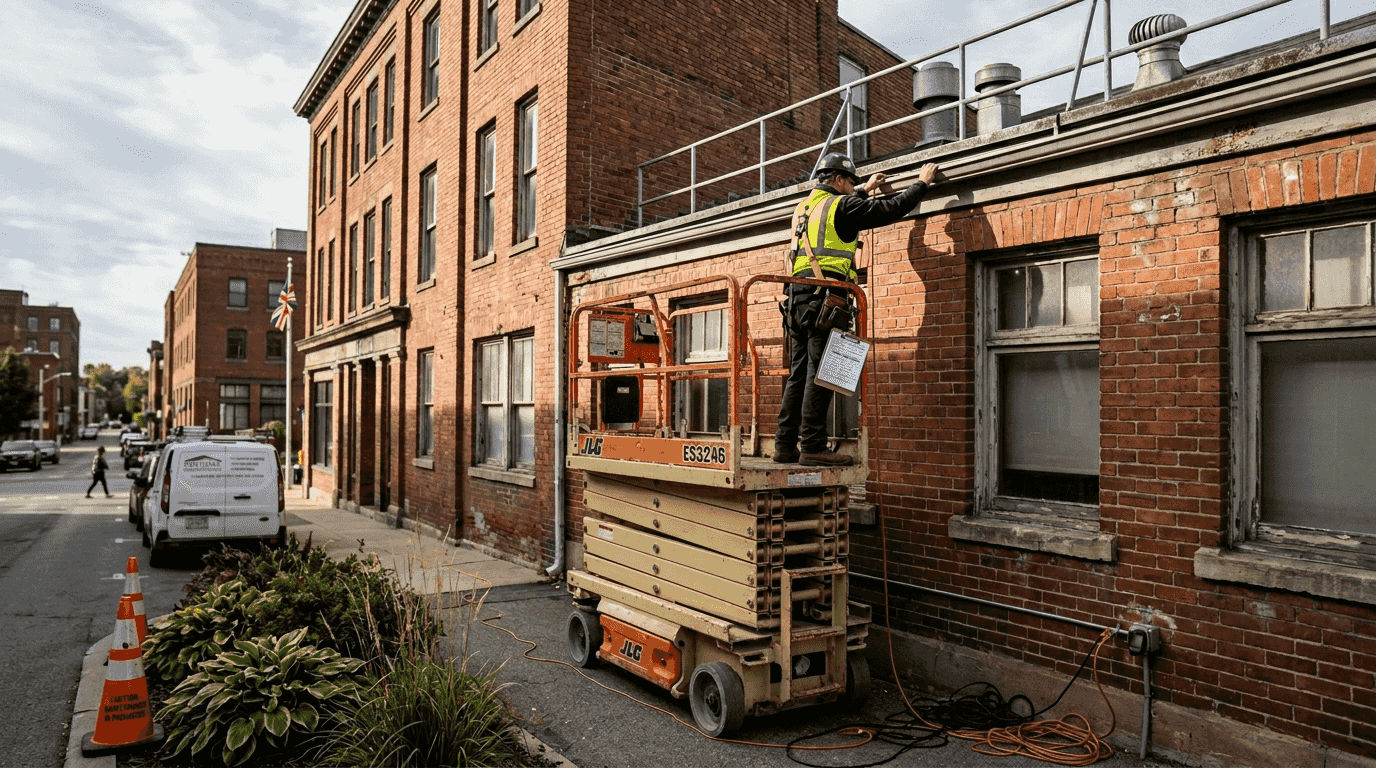
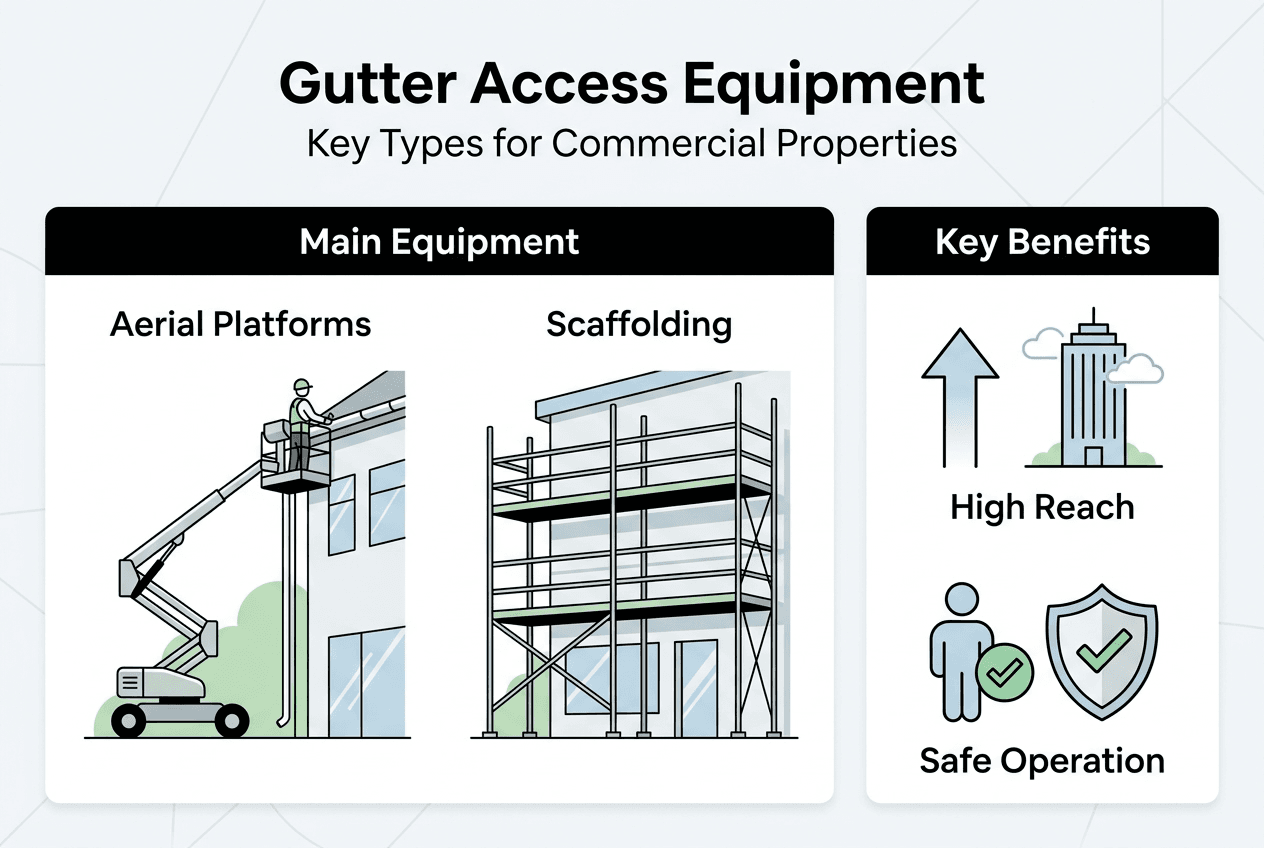
Aerial work platforms represent the gold standard for multi-storey commercial gutter access. The S2632E prioritises safety with features like control interlocks, pothole protection, speed limiting at height, and a load-sensing system. These platforms provide stable working positions at heights up to 10 metres, eliminating the instability and fatigue associated with ladder work. Electric models operate quietly for noise-sensitive environments, whilst diesel variants suit outdoor sites requiring extended range.
Scaffolding systems offer versatile access for extended maintenance programmes or buildings with complex architectural features. The HAILO G60 is an aluminium multipurpose scaffold with a ‘Fast & Lock’ closure for easy assembly, supporting load capacities suitable for multiple workers and equipment. Modular scaffolding adapts to irregular building profiles and provides secure platforms for detailed inspection work alongside cleaning.
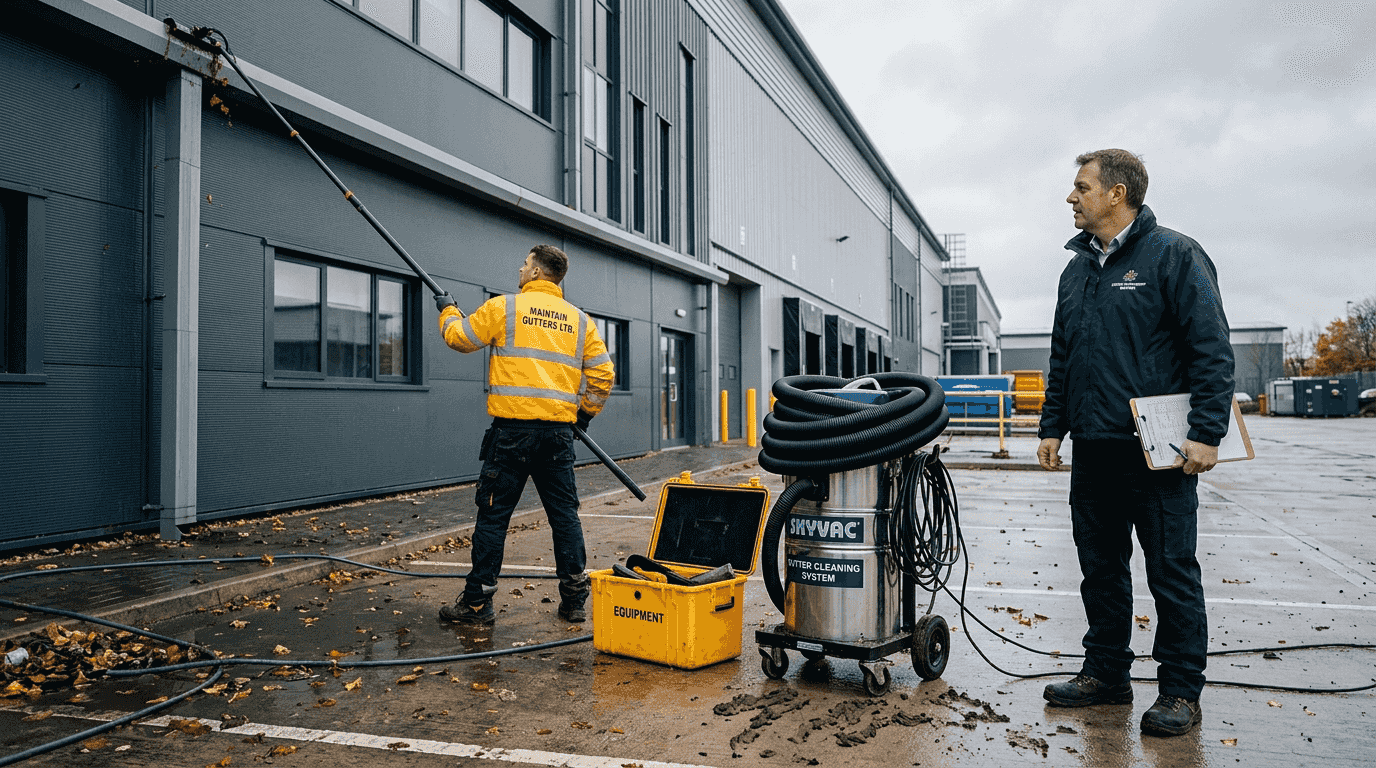
Gutter vacuum systems with telescopic poles revolutionise commercial cleaning by enabling ground-based operation. Commercial gutter vacuum systems deliver 3000-3600W for consistent suction and reduce cleaning time by nearly 40%. Carbon fibre poles extend 8-15 metres whilst remaining lightweight enough for extended use, and camera systems mounted on pole ends provide visual confirmation of thorough debris removal. This approach suits properties where AWP access proves difficult or cost-prohibitive.
| Equipment Type | Maximum Height | Setup Time | Mobility | Best Application |
|---|---|---|---|---|
| Scissor Lift AWP | 10m | 15-20 min | Moderate | Multi-storey buildings, open access |
| Telescopic AWP | 16m+ | 20-30 min | Limited | Very tall buildings, complex access |
| Aluminium Scaffold | Variable | 45-90 min | Static | Extended projects, detailed work |
| Vacuum with Poles | 15m | 5-10 min | Excellent | Standard gutters, restricted access |
Each system presents trade-offs between height capacity, mobility, and setup efficiency. AWPs excel for buildings requiring frequent access across multiple levels, whilst vacuum systems optimise routine maintenance on standard commercial properties. Understanding these distinctions helps property managers allocate resources effectively across diverse property portfolios.
Pro tip: Always specify equipment with reach capacity 20-30% beyond your typical working height to account for awkward angles, architectural features, and safety margins during actual operations.
Integrating commercial gutter vacuum solutions with appropriate access equipment creates comprehensive maintenance capabilities. Property managers benefit from reviewing the complete commercial gutter cleaning process to understand how equipment selection impacts overall service delivery.
Power requirements and generator considerations for gutter equipment
Commercial gutter vacuum systems demand substantial electrical power that often exceeds site availability, making generator selection a critical infrastructure decision. Property managers who overlook power specifications face equipment failures, incomplete jobs, and frustrated maintenance teams.
Understanding the distinction between starting watts and running watts proves essential for reliable generator selection. Vacuum motors require significant surge power during startup, typically 2-3 times their running wattage. Generators need to handle 7,500 to 10,000 starting watts for 240V commercial gutter vacuum systems. A vacuum rated at 3600W running power might demand 9000W during the critical first seconds of operation. Generators lacking adequate surge capacity either fail to start the motor or trip protection circuits repeatedly.
True split-phase 120/240V output distinguishes suitable generators from inadequate models. Commercial vacuum motors require proper 240V power delivery, not simply two 120V outputs that some generators provide. The electrical configuration must match motor specifications precisely, as voltage mismatches cause motor damage, reduced performance, and safety hazards.
Inverter generators, whilst popular for their quiet operation and fuel efficiency, often prove unsuitable for high-demand vacuum systems. Their power delivery characteristics and surge limitations rarely meet the aggressive startup demands of commercial motors. Conventional generators with robust alternators and adequate surge ratings provide the reliability professional operations require.
| Generator Specification | 3000W Vacuum | 3600W Vacuum | 4000W Vacuum |
|---|---|---|---|
| Minimum Starting Watts | 7,500W | 9,000W | 10,000W |
| Running Watts Required | 3,500W | 4,200W | 4,600W |
| Recommended Output Type | Split-phase 240V | Split-phase 240V | Split-phase 240V |
| Fuel Tank Capacity | 15+ litres | 20+ litres | 25+ litres |
Property managers should verify generator specifications before purchase, confirming both surge capacity and voltage configuration match vacuum requirements. Rental equipment requires the same scrutiny, as inadequate generators waste time and money through failed startups and incomplete cleaning cycles.
Pro tip: Always test generator and vacuum compatibility before deploying to a job site, running the system through multiple startup cycles to confirm reliable operation under load.
“Selecting the right access equipment is not just about reaching the gutters; it’s about ensuring the safety of the workers and the efficiency of the cleaning process.”
Integrating proper power infrastructure with quality equipment creates the foundation for professional commercial gutter cleaning service delivery. Property managers who invest in compatible systems avoid the frustration and expense of equipment mismatches during critical maintenance windows.
Ensuring safety and operational efficiency through maintenance and best practices
Neglected equipment maintenance represents one of the most preventable sources of accidents, project delays, and cost overruns in commercial gutter cleaning operations. Regular inspection and maintenance of gutter access equipment reduce the risk of accidents by up to 70%, yet many property managers underestimate the critical importance of systematic maintenance schedules.
AWPs require particular attention to hydraulic systems, control mechanisms, and safety interlocks. Hydraulic fluid levels, hose condition, and cylinder operation demand monthly inspection, with immediate attention to any leaks or unusual operation. Control interlocks prevent dangerous movements when the platform is elevated, and their proper function must be verified before each use. Load-sensing systems protect against overloading, but only when properly calibrated and maintained.
Vacuum systems need regular filter cleaning, hose inspection, and motor servicing to maintain performance and prevent failures. Blocked filters reduce suction dramatically, forcing motors to work harder and shortening their operational life. Ignoring regular maintenance leads to costly repairs and downtime; proactive schedules are essential. Carbon fibre poles require inspection for stress cracks, particularly at connection points where repeated assembly creates wear patterns.
Implementing a structured maintenance schedule protects both equipment investment and worker safety:
- Daily pre-use inspections covering visible damage, control function, and safety systems
- Weekly detailed checks of hydraulics, electrical connections, and structural integrity
- Monthly servicing including filter replacement, fluid changes, and wear component assessment
- Annual professional inspection and certification for AWPs and scaffolding systems
Best practices for safe operation extend beyond equipment condition to encompass training, site assessment, and operational protocols. Workers must receive proper training on each equipment type, understanding not just operation but also recognition of potential hazards and emergency procedures. Site assessments identify ground conditions, overhead obstacles, and environmental factors that influence safe equipment deployment.
“Proactive maintenance doesn’t just prevent accidents, it ensures equipment performs reliably when you need it most, protecting project schedules and worker confidence.”
Property managers should establish clear documentation systems tracking maintenance activities, inspection findings, and repair histories. This documentation proves invaluable for warranty claims, regulatory compliance, and informed equipment replacement decisions. Digital maintenance logs accessible via mobile devices enable real-time updates and systematic oversight across multiple properties.
Understanding comprehensive gutter safety best practices helps property managers create safety cultures that prioritise prevention over reaction. Equipment maintenance forms just one component of holistic safety management, but its impact on accident prevention makes it a critical focus area.
Trusted gutter cleaning services for commercial properties
Whilst understanding equipment specifications empowers better decision making, many property managers find that partnering with specialist commercial gutter cleaning services delivers superior results without the capital investment and maintenance burden of equipment ownership. Professional services bring not just equipment but expertise, insurance coverage, and systematic processes that optimise safety and efficiency.
Our commercial gutter cleaning specialists operate throughout London with the advanced access equipment, powerful vacuum systems, and trained personnel that commercial properties demand. We maintain comprehensive insurance coverage and follow rigorous safety protocols that protect your property and our team. Whether you manage properties in Greenwich, Deptford, or across Greater London, our local teams deliver prompt, professional service tailored to commercial requirements. Understanding the commercial property cleaning importance helps property managers recognise when specialist services offer better value than in-house capabilities.
Frequently asked questions
Which gutter access equipment is best for multi-storey commercial buildings?
Aerial work platforms and high-reach vacuum systems with telescopic poles enable safe, efficient cleaning on multi-storey buildings without dangerous ladder work. AWPs provide stable working platforms up to 16 metres, whilst vacuum systems with 12-15 metre carbon fibre poles allow ground-based operation. Extended poles dramatically reduce scaffolding requirements, cutting both setup time and costs whilst improving safety outcomes.
How do I choose the right generator for a commercial gutter vacuum?
Select generators with 7,500+ starting watts and true split-phase 120/240V output to match commercial vacuum motor demands. Verify the generator provides adequate surge capacity, typically 2.5-3 times the vacuum’s running wattage, and confirm voltage configuration matches your specific equipment. Always ensure a safety margin above the vacuum motor’s surge watts for reliable startup, and test compatibility before deploying to job sites.
What maintenance should be prioritised for aerial work platforms?
Regularly inspect controls, safety interlocks, hydraulic systems, and structural components following manufacturer guidelines and HSE requirements. Focus on hydraulic fluid levels, hose condition, and cylinder operation during monthly checks, with immediate attention to any leaks or unusual sounds. Schedule preventative servicing annually with certified technicians, and maintain detailed documentation of all inspections, repairs, and safety tests to ensure regulatory compliance.
Why is commercial gutter equipment more expensive but worth the investment?
Higher power ratings, robust construction, and advanced safety features reduce job completion time by up to 40% whilst preventing costly accidents and liability claims. Commercial equipment withstands daily professional use without frequent repairs, and safety systems protect workers whilst lowering insurance premiums. The equipment typically pays for itself within 12-18 months through improved efficiency, reduced labour costs, and eliminated equipment replacement cycles that plague residential-grade tools used commercially.
Leave A Comment