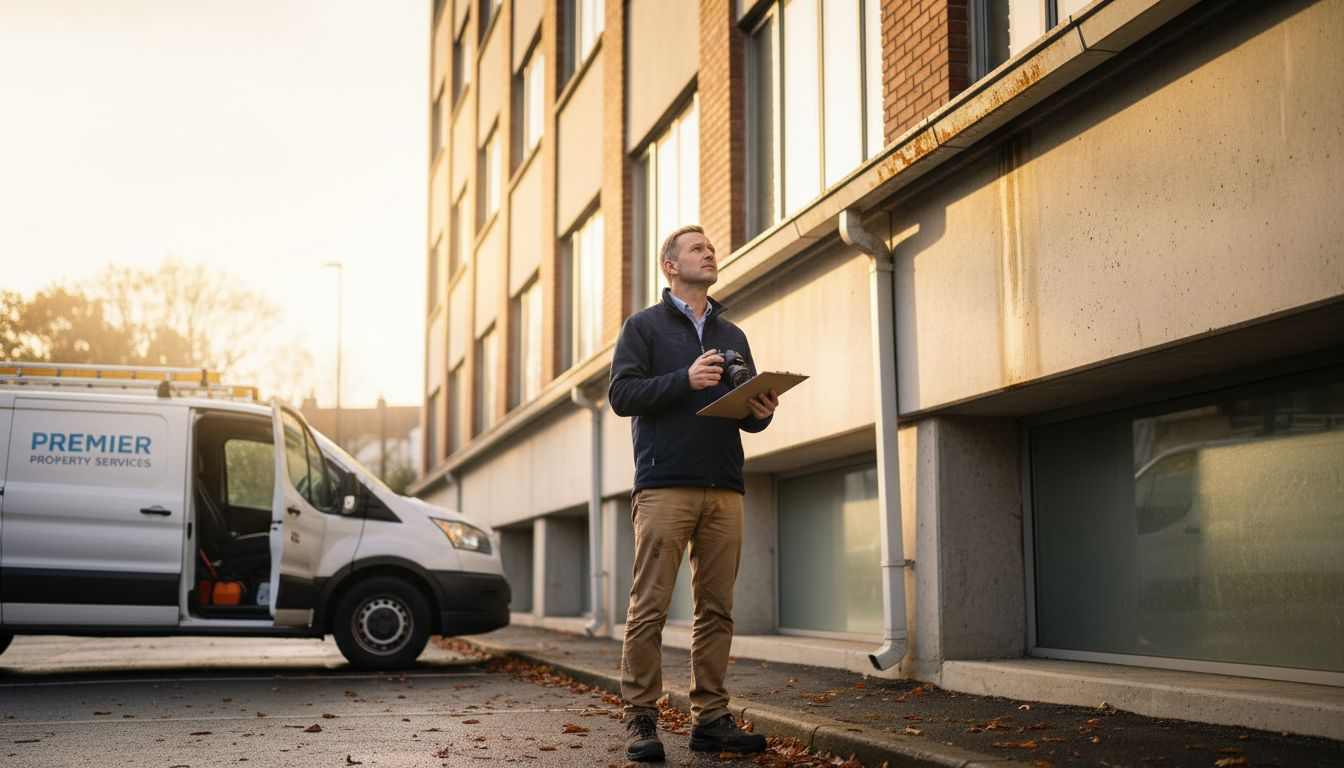
Blocked gutters can silently undermine even the most robust commercial properties, leaving hidden damp patches, frustrated tenants, and mounting repair bills in their wake. Property managers face unique obligations when it comes to drainage maintenance, with statutory duties under British law requiring regular inspections and prompt action. Understanding gutter health and challenging common misconceptions helps prevent structural damage, reduce liability, and protect tenant satisfaction—key to keeping your building safe and valued long-term.
Table of Contents
- Gutter Health Defined and Misconceptions
- Types of Gutter Systems in Urban Properties
- How Gutters Prevent Structural and Water Damage
- Legal Obligations and Safety Requirements
- Risks, Costs, and Common Maintenance Pitfalls
Key Takeaways
| Point | Details |
|---|---|
| Understanding Gutter Health | Gutter health is crucial for effective drainage, preventing water damage, and maintaining structural integrity. Regular inspections and maintenance are necessary to mitigate risks. |
| Common Misconceptions | Many property managers underestimate the frequency and responsibility of gutter maintenance, assuming annual cleaning suffices, which can lead to significant damage. |
| Legal Obligations | Property managers are legally responsible for maintaining gutters, and neglect can result in liability issues and increased costs from water damage claims. |
| Financial Implications | Delaying gutter maintenance can cause costs to escalate massively, with simple cleaning transforming into expensive repairs if not addressed promptly. |
Gutter Health Defined and Misconceptions
Gutter health refers to the overall condition and functionality of your building’s drainage system. This includes whether gutters are clear, structurally sound, properly sloped, and effectively channelling water away from the property.
Many property managers operate under false assumptions about gutters. These misconceptions can lead to costly damage, tenant complaints, and liability issues down the line.
What Actually Constitutes Gutter Health
Healthy gutters perform three critical functions:
- Remove water efficiently from the roof surface
- Direct water safely away from the building foundation
- Prevent water from entering walls, basements, or ground floors
When gutters fail, water pools or spills onto external walls, infiltrating the building envelope. Landlords are generally responsible for maintaining and repairing gutters, including regular inspections and debris removal.
Poor gutter health doesn’t just cause cosmetic damage—it directly threatens structural integrity and exposes you to significant liability.
Common Misconceptions Property Managers Hold
Misconception one: “Gutters only need cleaning when leaves are visibly overflowing.”
Actually, debris accumulates silently. By the time you see blockages, water damage may already be occurring inside walls. Professional gutter cleaning misconceptions worth understanding help clarify when intervention is truly needed.
Misconception two: “Annual cleaning is sufficient for all buildings.”
Urban commercial buildings accumulate debris differently than suburban properties. Multi-storey blocks often require twice-yearly cleaning depending on nearby trees and pollution levels.
Misconception three: “Tenants should handle gutter maintenance.”
This exposes you legally. Statutory obligations require property managers to maintain buildings in safe condition, preventing hazards like water ingress and structural damage.
Misconception four: “Gutters are low-priority compared to other building systems.”
Gutter failure cascades into foundation problems, damp, structural deterioration, and tenant disputes. A blocked gutter costs £50–200 to clear. Water damage remediation costs thousands.
Why This Matters for Your Bottom Line
Neglecting gutter health directly impacts your financial position:
- Tenant retention suffers when damp appears
- Insurance claims become complicated or rejected
- Property valuations drop due to water damage history
- Emergency repairs cost multiples of preventative maintenance
Pro tip: Establish a documented gutter inspection schedule (spring and autumn minimum) and photograph conditions each visit. This creates evidence of responsible management if disputes arise.
Types of Gutter Systems in Urban Properties
Urban commercial buildings rarely use a one-size-fits-all gutter approach. Your property’s drainage system depends on roof pitch, rainfall intensity, building materials, and tenant expectations.
Choosing the right gutter profile directly affects water management efficiency and long-term maintenance costs. Different systems suit different urban environments and building characteristics.
Common Gutter Profiles Found in Urban Properties
Most urban buildings utilise one of these primary gutter types:
- Half-round gutters: Curved design, ideal for period buildings and listed properties. Lower capacity but aesthetically pleasing.
- Square gutters: Maximised internal capacity, modern appearance. Suit contemporary commercial buildings.
- Ogee gutters: Decorative profile with excellent water flow. Common in mixed-use developments.
- Deepflow gutters: Highest capacity option. Essential for high-rainfall areas or buildings with large roof areas.
Gutter profiles explained in detail shows how each design manages water differently based on shape and capacity.
Urban areas experience concentrated rainfall during storms. Your gutter’s internal volume determines whether water channels smoothly or backs up behind debris.
Here is a comparison of common gutter profiles for urban commercial properties:
| Gutter Profile | Capacity | Typical Use | Maintenance Difficulty |
|---|---|---|---|
| Half-round | Lower | Heritage and period buildings | Moderate |
| Square | High | Modern commercial premises | Slightly higher |
| Ogee | Moderate-High | Mixed-use developments | Moderate |
| Deepflow | Very high | High-rainfall/larger roofs | More frequent |
System capacity matters less than consistent cleaning. Even oversized gutters fail when leaves and sediment block water flow.
Why Urban Properties Need Different Solutions
Urban commercial buildings face specific drainage challenges that suburban properties don’t encounter.
Tall buildings experience wind pressure that forces water sideways, demanding gutters with reinforced seals. Dense buildings reduce air circulation, trapping moisture longer. Polluted air deposits residue that accelerates gutter deterioration.
Multi-storey blocks require gutters capable of handling concentrated water flow from larger roof areas. A four-storey building channels roughly four times the water volume of a single-storey property.
Nearby trees in urban parks or street landscaping drop leaves constantly. This isn’t seasonal—it’s ongoing throughout autumn and spring.
Understanding gutter cleaning challenges in urban properties helps you select systems that minimise blockage risk.
Material Considerations for Urban Gutters
Gutter materials vary in durability, maintenance, and cost:
- Aluminium — Lightweight, corrosion-resistant, suits most urban buildings. Typically lasts 20–30 years.
- Galvanised steel — Stronger but requires more maintenance. Prone to rust in high-pollution areas.
- Copper — Premium option with 50+ year lifespan. Expense limits use to heritage properties.
- Plastic — Budget-friendly but degrades in direct sunlight. Shorter replacement cycles.
Urban air pollution accelerates material degradation. Coastal properties face additional salt corrosion challenges.
Pro tip: Request material specifications when planning gutter replacement. Aluminium with internal brackets handles urban weather and pollution better than galvanised alternatives, offsetting higher initial costs through reduced maintenance demands.
How Gutters Prevent Structural and Water Damage
Gutters do far more than collect leaves. They actively protect your building’s most vulnerable areas from the constant assault of rainwater.
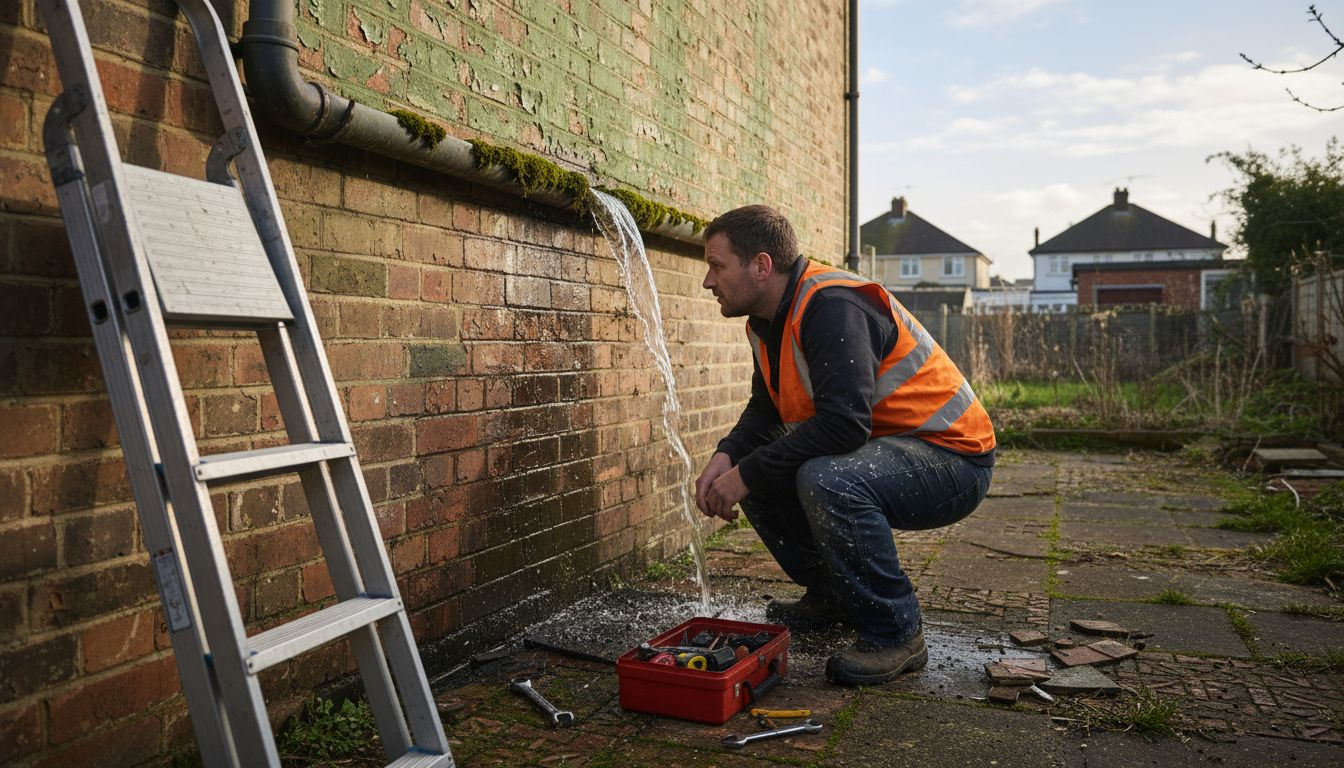
Without functional gutters, water runs unchecked down exterior walls, seeps into foundations, and triggers structural deterioration that costs tens of thousands to repair. This is preventative infrastructure, not decoration.
The Foundation Protection Role
Your building’s foundation sits directly beneath the guttering system. When gutters fail, water pools around the perimeter, creating several critical problems:
- Water pressure forces moisture into foundation cracks and mortar joints
- Soil around the foundation becomes waterlogged and unstable
- Foundations shift and crack under uneven pressure from wet and dry zones
- Basement and ground floor spaces develop damp and flooding
Gutters prevent foundation water damage and erosion by channelling water safely away from the building envelope. Without this protection, even well-built foundations deteriorate within years.
A single blocked gutter section allows water to cascade directly onto the foundation edge. Multiply this across a large commercial building and you have continuous water bombardment on your structural base.
Foundation repair costs typically exceed £15,000. Gutter maintenance costs under £200 annually. The mathematics are straightforward.
Wall Penetration and Damp Issues
Exterior walls absorb water when gutters overflow or when water runs down unfished surfaces. This penetrating damp travels horizontally through brick, concrete, and mortar.
Once moisture enters the wall cavity, it becomes trapped. Interior surfaces stay perpetually damp, creating conditions for mould growth and material degradation.
Tenants notice damp patches appearing on internal walls months after the initial gutter failure. By then, the problem has spread significantly. Remediation requires removing wall linings, drying out the structure, and treating affected areas.
Urban multi-storey buildings experience accelerated damp spread because water can travel vertically down cavity walls across multiple floors. A single gutter fault can affect tenant spaces two or three storeys below.
Structural Element Deterioration
Water damage weakens building materials progressively. Steel rusts, concrete cracks, timber rots, and masonry mortar disintegrates.
Problems develop in this sequence:
- Water infiltration begins (often unnoticed)
- Material saturation occurs over weeks and months
- Structural elements weaken silently
- Visible damage appears (cracking, sagging, bowing)
- Emergency repairs become unavoidable
Why gutters need regular checks explains how preventative inspections catch issues before structural damage accelerates.
Commercial buildings with compromised structural integrity face liability issues if collapse risk increases. Insurance becomes difficult to obtain or extremely expensive.
Pro tip: Photograph gutter and foundation conditions during spring and autumn inspections. Document water staining, soil displacement, or wall dampness. This evidence proves due diligence if structural issues emerge later.
Legal Obligations and Safety Requirements
Property managers often underestimate their legal exposure regarding gutter maintenance. Neglecting this responsibility creates liability that extends well beyond financial costs.
Under UK law, your obligations are clear and non-negotiable. Failure to maintain gutters exposes you to tenant claims, building regulation breaches, and insurance complications.
Your Statutory Duty to Maintain Gutters
The Landlord and Tenant Act 1985 establishes your fundamental responsibility for building maintenance. This includes gutters, drainage systems, and all structural elements that prevent water ingress.
As a property manager, you must:
- Maintain gutters and downpipes in working condition
- Repair structural defects caused by water damage
- Inspect systems regularly to identify problems early
- Act promptly when tenants report issues
- Keep maintenance records documenting your actions
Landlord obligations for gutter maintenance clarify that you remain responsible regardless of lease terms. Tenants cannot be held liable for structural drainage failures.
This isn’t optional or discretionary. Courts view gutter neglect as breach of statutory duty if water damage follows.
Ignoring a tenant’s gutter complaint creates documented negligence. That evidence becomes damaging in any subsequent legal claim.
Safety Hazards and Building Regulations
Gutter failures create multiple safety hazards beyond water damage. Blocked gutters become breeding grounds for bacteria and mould spores. Standing water attracts insects and rodents. Overflowing gutters create slip hazards on pathways and vehicle surfaces.
Building Regulations require gutters to manage water effectively without creating health risks. Failure to comply creates enforcement action from local authorities.
Tenant safety claims arising from gutter-related hazards can include:
- Respiratory issues from mould growth
- Allergic reactions to airborne spores
- Slip and fall injuries from water overflow
- Property damage from water ingress
Your liability insurance typically excludes claims resulting from negligent maintenance. If a tenant sustains injury because you ignored a gutter problem, the insurer may deny coverage.
Documentation and Liability Protection
Maintain detailed records of all gutter-related activities. This creates evidence of responsible management if disputes arise.
Document the following:
- Inspection dates and findings
- Cleaning or repair work completed
- Costs and service provider details
- Tenant complaints and your response times
- Photographs showing conditions before and after work
Commerical properties face heightened scrutiny. Large buildings with multiple tenants generate significant liability exposure if structural damage occurs across numerous units.
Insurance companies increasingly demand proof of preventative maintenance before paying water damage claims. Without documentation, you cannot demonstrate due diligence.
Pro tip: Establish a formal gutter maintenance schedule and communicate it to all tenants in writing. Include inspection dates, cleaning frequency, and contact procedures for reporting problems. This demonstrates active management and protects you legally.
Risks, Costs, and Common Maintenance Pitfalls
Neglected gutters don’t just cause inconvenience—they trigger a cascade of escalating problems that multiply repair costs exponentially. Property managers who delay gutter maintenance inevitably face financial and legal consequences.
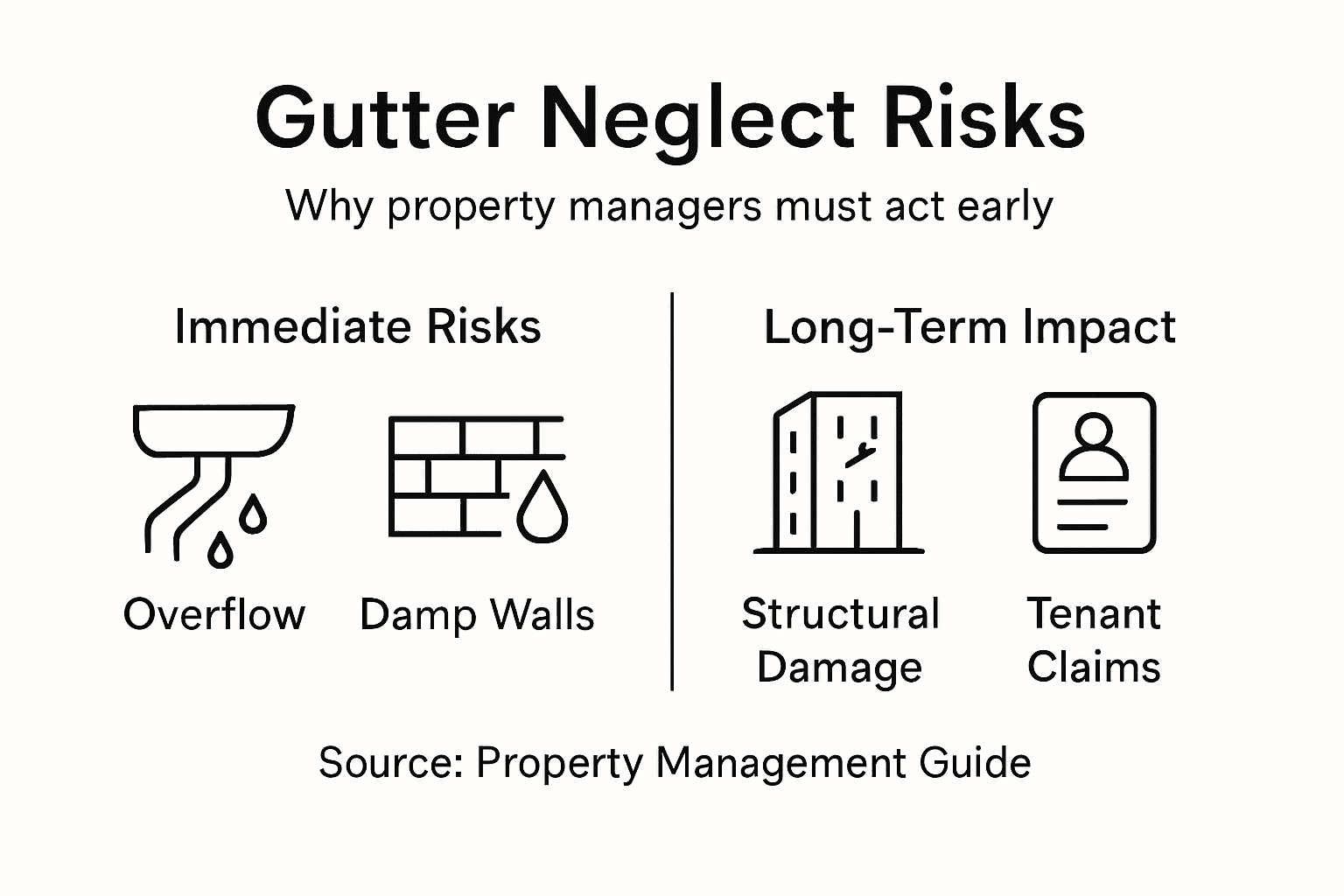
Understanding the real costs of inaction helps justify preventative spending to stakeholders and budgets.
Financial Impact of Gutter Neglect
The mathematics of gutter failure are stark. Preventative cleaning costs £50–200 per visit. Reactive repairs after damage multiply these expenses dramatically.
Common cost escalation patterns include:
- Blocked gutter cleaning: £80–150
- Gutter repair or section replacement: £400–800
- Downpipe unblocking: £100–250
- Foundation stabilisation: £5,000–15,000
- Damp remediation across multiple units: £8,000–20,000
- Structural repairs from prolonged water damage: £15,000–50,000+
A single neglected gutter section can trigger foundation issues affecting the entire building. Debris clogging represents the primary cause of gutter failure, yet remains preventable through regular cleaning.
Urban commercial properties with multiple storeys amplify these risks. Water damage cascading through cavity walls affects numerous tenant spaces, generating widespread claims and remediation costs.
One blocked gutter costs under £150 to clear. The same fault unaddressed costs £25,000 to repair properly.
Common Maintenance Pitfalls Property Managers Make
Pitfall one: Waiting for visible overflow before acting.
Blockages develop internally long before water spills over gutters. By the time overflow appears, water damage is likely already occurring inside walls. Early warning signs like partial blockages go unnoticed during routine inspections.
Pitfall two: Underestimating debris accumulation rates.
Urban buildings with nearby trees, pollution, and bird activity accumulate debris far faster than property managers anticipate. Annual cleaning proves insufficient. Most commercial properties require twice-yearly maintenance, yet many operate on single annual schedules.
Pitfall three: Ignoring sagging gutters as cosmetic issues.
Sagging indicates structural weakness and blockage. This compromises water flow efficiency and creates pooling zones where debris accumulates rapidly. Addressing sagging early prevents larger structural failures.
Pitfall four: Hiring untrained personnel for gutter work.
Common gutter cleaning mistakes affect property integrity. Improper cleaning techniques damage gutter linings, downpipes, and fascia boards. Untrained workers miss critical structural problems requiring professional attention.
Key maintenance pitfalls and their potential business consequences:
| Common Pitfall | Immediate Risk | Longer-term Business Impact |
|---|---|---|
| Delaying action until overflow | Concealed internal water damage | Expensive structural repairs |
| Underestimating debris rate | Rapid blockage and overflow | Increased tenant complaints |
| Overlooking sagging gutters | Water pooling and leaks | Accelerated material decay |
| Using untrained staff | Missed or worsened faults | Legal and insurance issues |
Pest and Health Hazards from Blocked Gutters
Standing water in blocked gutters becomes a breeding ground for insects, mosquitoes, and bacteria. Decomposing organic matter creates foul odours that affect adjacent spaces.
Hazards include:
- Mosquito breeding in pooled water
- Bird nesting and droppings accumulation
- Mould spore dispersal into building interiors
- Bacterial growth creating respiratory hazards
- Rodent access through drainage systems
Tenants exposed to these hazards have legitimate health and safety claims. Your liability extends beyond property damage to personal injury claims.
Pro tip: Schedule gutter inspections immediately after autumn leaf-fall and again in spring. This captures peak debris periods and allows time to address issues before heavy rainfall seasons create emergency situations.
Protect Your Property with Expert Gutter Cleaning Solutions
Property managers know that gutter health is critical to preventing costly water damage, structural issues, and tenant complaints. Ignoring blocked or damaged gutters invites urgent repairs that can escalate from a simple cleaning costing under £200 to foundation remediation bills in the tens of thousands. At Local Gutter Cleaner, we specialise in servicing blocks of flats and commercial buildings, helping you maintain gutters that efficiently remove water and safeguard your investment.
Don’t wait until overflow or sagging gutters cause irreversible damage. Take control now with our tailored gutter cleaning service designed to tackle urban property challenges, including heavy debris from nearby trees and pollution. Visit Local Gutter Cleaner to schedule a professional inspection and benefit from peace of mind knowing your gutters are inspected and maintained regularly. Learn more about common maintenance pitfalls and how to avoid them at Why gutters need checks and discover how tailored solutions can protect your building at Gutter cleaning challenges in urban properties. Act today to prevent high costs and demonstrate your commitment to legal obligations and tenant safety.
Frequently Asked Questions
What is gutter health?
Gutter health refers to the overall condition and functionality of your building’s drainage system, ensuring it effectively channels water away from the property and prevents structural damage.
How often should gutters be cleaned?
Most urban properties require gutter cleaning at least twice a year, especially if they are near trees or in pollution-heavy areas. Urban buildings often accumulate debris more quickly than suburban ones, making annual cleaning insufficient.
What are the consequences of poor gutter maintenance?
Neglecting gutter maintenance can lead to serious issues such as water ingress, foundation damage, and structural deterioration. It can also result in expensive repairs, decreased property value, and potential liability claims from tenants.
Are property managers legally responsible for gutter maintenance?
Yes, property managers are legally obligated to maintain gutters and ensure they are working properly to prevent water damage and safety hazards, in accordance with the Landlord and Tenant Act 1985.

[…] case studies for additional examples of successful gutter protection strategies. Understanding expert gutter recommendations helps property managers prioritise investments that deliver maximum protection and cost […]
[…] why gutter health matters helps property managers prioritise maintenance budgets and protect their investments from […]